Swiss Italian vs. Standard Italian: What is the Difference?
While they are mutually intelligible, Swiss Italian (Italiano Svizzero) is a distinct national variety characterized by Helvetisms (loanwords from French/German), unique administrative terminology, and the absence of the remote past tense (passato remoto). Unlike a dialect, it is the official language of government, law, and media in Canton Ticino and the Grisons. To help you navigate these nuances, here are the critical differences every expat and business professional must know.
Last updated: October 22, 2026
What are the most dangerous "False Friends" in Swiss Italian?
The biggest risk for expats and businesses in Ticino is not the accent—it is using words that have completely different (and often embarrassing) meanings in Italy. AI translation tools often miss these nuances, leading to awkward situations.
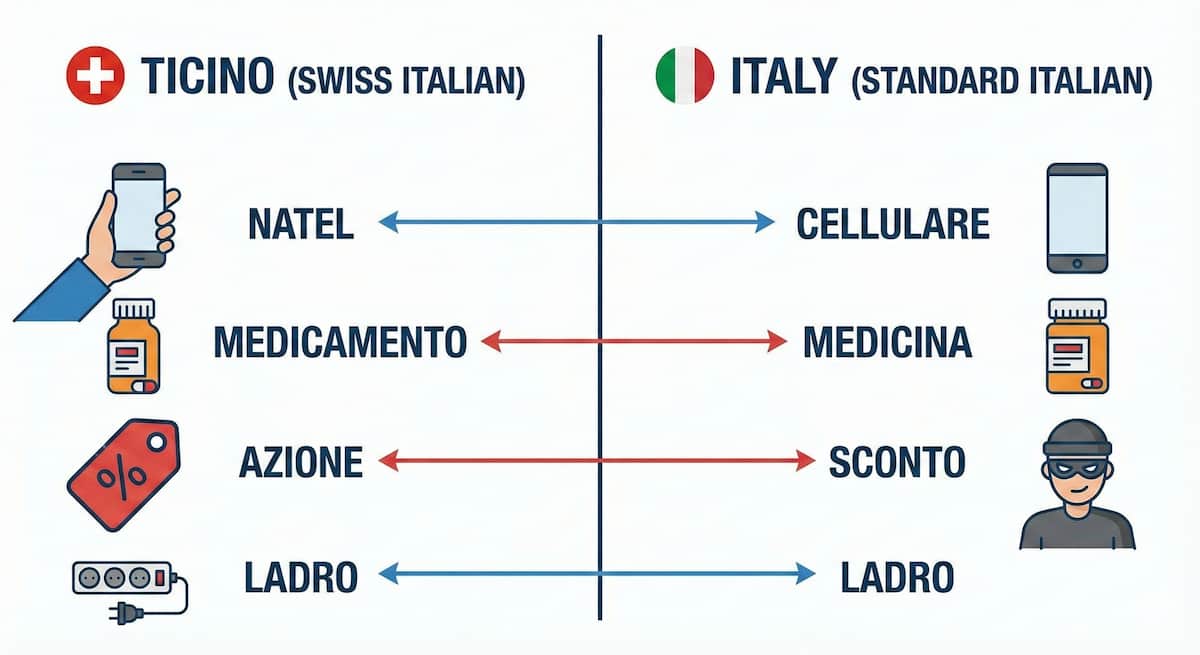
Is "Ladro" a thief or a household object?
This is the classic Swiss-Italian trap:
In Italy: Ladro means "Thief" (a criminal).3
In Ticino: Ladro is the standard word for a Multi-Plug Power Strip (also called a "benjamino").
Context: Asking a colleague "Hai un ladro?" (Do you have a thief?) in Milan will cause alarm. In Lugano, it simply means you need to charge your laptop.
Other Common Confusions
Meteo: In Switzerland, Il Meteo is masculine. In Italy, La Meteo (short for meteorologia) is often treated differently, but usage varies. In Ticino, strictly use the masculine form.
What are "Helvetisms" and why do they exist?
Ticino is part of the Swiss federal system, which operates in German, French, and Italian. Consequently, Swiss Italian adopts the "bureaucratic logic" of its neighbors rather than linguistic purity from Florence.
These loanwords are called Helvetisms. They allow the Swiss administration to maintain consistent terminology across language borders (German, French, Italian).
Swiss Italian Vocabulary Cheat Sheet: Which words should I use?
Below is a comparison of essential terms. To sound like a local, use the Swiss variant.
English Concept | 🇨🇭 Swiss Italian (Say This) | 🇮🇹 Standard Italian (Avoid) | Origin / Note |
Mobile Phone | Natel | Cellulare | Unique Swiss acronym (Nationales Auto-Telefon). |
Medication | Medicamento | Farmaco / Medicina | Loanword from German Medikament. |
Reservation | Riservazione | Prenotazione | Loanword from French Réservation. |
Agenda Item | Trattanda | Ordine del giorno | Critical term for business meetings. |
Change (Money) | Ritorno | Resto | "Il vostro ritorno" (Here is your change). |
Discount/Sale | Azione | Sconto / Offerta | From German Aktion. |
How does business etiquette differ in Ticino?
In a professional setting, using "Italy-Italian" can subtly signal that you don't understand the Swiss legal or corporate framework.
1. Are titles important in Switzerland?
Yes. Swiss business culture is more formal than in Italy. The use of titles like Direttore, Avvocato, or Ingegnere is common and expected during introductions until invited to use first names.
2. How do I discuss finance (The "Bilancio")?
In Switzerland, financial reporting follows specific federal standards.4 Using local terms demonstrates insider knowledge:
Cifre nere: Black figures (Profit).
Cifre rosse: Red figures (Loss).
3. Which grammar tense should I use?
Avoid the Passato Remoto. The remote past tense is almost non-existent in Swiss Italian speech and business writing. In Ticino correspondence, sticking to the Passato Prossimo is the strict rule.
Why is localizing for Swiss Italian important?
If you are living or doing business here, "Standard Italian" is not always enough.
Professional Competence: Using terms like Trattanda or Bilancio correctly in a meeting shows you understand the Swiss legal framework, not just the language.
Avoid Medical Errors: In healthcare, precision matters. Using Swiss terminology like Cassa Malati (Health Fund) instead of the Italian Mutua ensures your insurance claims are understood and processed without confusion.
Cultural Respect: Ticino is proud of its identity and is not a "suburb of Milan." Adopting local terms is a sign of respect for the distinct Swiss-Italian culture that balances Mediterranean warmth with Federal precision.
Frequently Asked Questions
- Is Swiss Italian a different language?
- No. It is a regional variety of Standard Italian. They are 100% mutually intelligible, though some specific vocabulary differs.
- What is the difference between Swiss Italian and Ticinese?
- This is a common point of confusion. Swiss Italian is the official standard language used in schools and offices. Ticinese is a local Lombard dialect used informally among families and in small villages; it can be very difficult for outsiders to understand.
- Do I need to learn "Swiss Italian" separately?
- If you speak Standard Italian, you are 95% of the way there. You simply need to learn the "Helvetisms" related to daily life, such as transport, shopping, and administration.
- Is Swiss Italian considered a dialect?
- No. Swiss Italian is a standard national language taught in schools and used in government. However, the Ticinese Dialect (Dialetto Ticinese) is a separate, spoken-only vernacular related to Western Lombard, used informally among locals.
- Will Italians understand me if I speak Swiss Italian?
- Yes, 99% of the language is identical. However, using specific Helvetisms like Natel or Ladro will cause confusion in Italy.